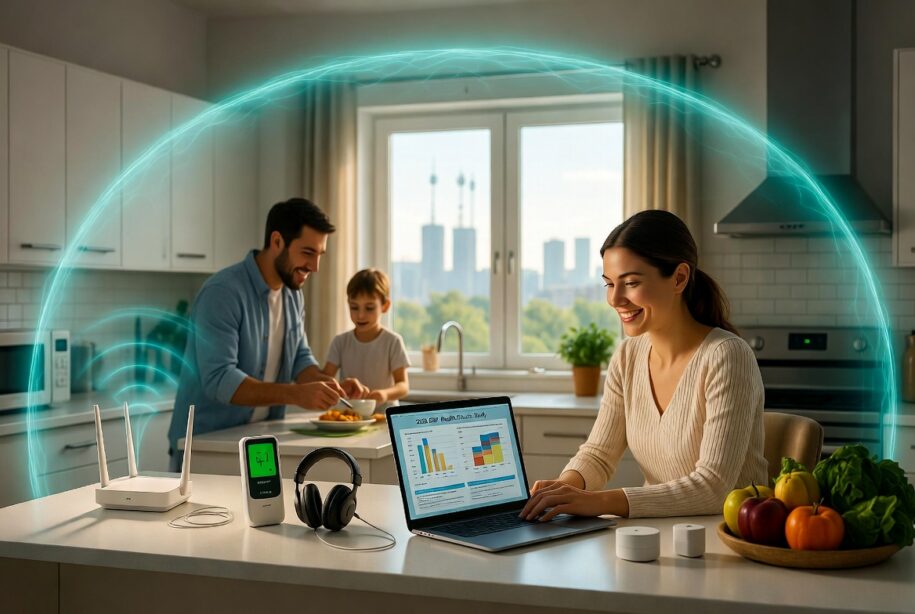
Understanding EMF Exposure in 2026
Hey friend, grab a coffee and let’s talk about something that’s been on a lot of parents’ minds lately: EMF health effects. If you’ve found yourself wondering whether your phone, WiFi router, or the new 5G tower down the street might be affecting your family’s sleep, mood, or long-term health, you’re not alone.
I’m here to give you the straight story based on the latest 2026 evidence, without the hype or fear-mongering. We’ll look at what the World Health Organization, ICNIRP, and major systematic reviews actually say, and then focus on simple, practical things you can do today that make sense.

The good news? The consensus from high-quality research remains reassuring for typical everyday exposure levels. But that doesn’t mean we can’t be thoughtful and take sensible steps to lower exposure where it’s easy. That’s exactly what we’ll cover.
What the Latest Science Says
Let’s start with the heart of it. Systematic reviews from the WHO and PubMed-indexed sources through early 2026 continue to show that exposure to radiofrequency electromagnetic fields (that’s the RF-EMF from our wireless tech) at levels below international safety guidelines does not show consistent evidence of adverse health effects in humans.
Thermal effects (basically, the heating of tissue) are very well understood and strictly regulated. The trickier question is whether there are non-thermal biological effects at everyday levels. The current body of evidence remains inconclusive, with many well-designed studies showing no effect and others struggling with reproducibility.
This is actually comforting news. It means the devices we rely on every day—phones, laptops, routers—fall well within safety thresholds according to the experts who have spent decades studying this.

Try this today:
Take one deep breath and remind yourself that worry itself can affect your sleep more than the fields around you. Knowledge is calming. You’re already taking the best first step by learning the actual evidence.
Key Systematic Reviews and Findings
The World Health Organization’s 2025 updated review of radiofrequency electromagnetic fields and health found no established causal link between low-level RF-EMF and cancer, reproductive effects, or neurological disorders when exposure stays below current guidelines [1].
A 2025 systematic review and meta-analysis on RF-EMF and sleep quality by Zhang et al. discovered no significant association in double-blind studies. The self-reported effects people sometimes notice simply didn’t show up when participants didn’t know whether the EMF was on or off [2].
The International Commission on Non-Ionizing Radiation Protection (ICNIRP) released a 2026 statement confirming that current exposure limits remain protective for 5G and higher frequencies. No new evidence required them to change the guidelines [3].
Large cohort studies, including the 2024 update by Karipidis et al., continue to show no increase in brain tumors like glioma or acoustic neuroma despite massive increases in mobile phone use [4].
Even the meta-analysis on oxidative stress markers by Halgamuge et al. (2025) found that while some lab studies show changes, the human evidence is weak and most positive findings occurred at exposure levels far above what we experience in real life [5].
Try this today:
Save one of the studies above in a folder called “EMF Evidence.” When worry creeps in at 2 a.m., you’ll have the actual papers instead of scary social media posts.
Limitations of Current Research
Science is never perfect. The researchers themselves are honest about the challenges: it’s hard to measure long-term exposure accurately, new technologies like 5G move faster than some studies can keep up with, and self-reported symptoms (especially with electromagnetic hypersensitivity) are difficult to study in truly blinded conditions.
Most studies showing effects have significant limitations or can’t be reproduced. This is normal in science, especially with something as complex as electromagnetic fields interacting with our bodies.
Try this today:
When you see a scary headline, ask yourself: “Is this a systematic review of many studies, or just one study?” Systematic reviews carry much more weight.
Regulatory Guidelines from WHO, FDA & ICNIRP
The FDA reaffirmed in January 2026 that wireless devices remain safe for consumer use amid new 5G rollout concerns [6]. ICNIRP, the independent body that sets the international guidelines, states that existing limits protect against all known health effects.
These aren’t industry guidelines—they’re set by independent scientists and regularly reviewed with new data.
Try this today:
Visit the WHO and ICNIRP websites directly. Seeing the actual organizations instead of cherry-picked quotes feels grounding.
Common Sources of Everyday EMF
Your biggest sources of RF-EMF are usually the devices closest to you: cell phones, tablets, WiFi routers, and wireless earbuds. Cell towers and 5G infrastructure actually expose you to much lower levels because distance reduces exposure dramatically thanks to the inverse square law.
Understanding this helps you focus your energy where it matters most—on the devices you hold against your body.

Try this today:
Walk around your house with your phone on airplane mode and notice where the signal bars drop. Those are the areas with less RF exposure.
Evidence-Based Protection Strategies
Here are the strategies that actually make sense according to physics and the current evidence:
- Increase distance from RF sources when possible (the inverse square law means exposure drops very quickly with distance)
- Use speakerphone or wired headsets for long calls
- Turn off WiFi and Bluetooth on devices when not in use, especially at night
- Limit children’s screen time on wireless devices and prefer wired connections
- Avoid sleeping with your phone directly under your pillow or on the bedside table
- Check local RF measurement reports to understand ambient levels in your area
| Action | Effort Level | Impact |
|---|---|---|
| Use speakerphone or wired headset | Very Easy | High |
| Keep phone away from body when not in use | Easy | High |
| Turn off WiFi at night | Easy | Medium |
| Use airplane mode while sleeping | Easy | Medium |
Try this today:
Move your WiFi router 3 feet farther from where you or your kids spend the most time. You’ll be amazed how much the signal (and exposure) drops.
Evaluating EMF Protection Products
Let’s be honest with each other. Most consumer “EMF protection” stickers, pendants, and harmonizers have no credible peer-reviewed evidence showing they work. Physics doesn’t support their claims.
Distance-based solutions (like longer charging cables or keeping your phone across the room) are strongly supported by basic physics. Some shielding materials tested to IEEE standards can provide partial attenuation for specific frequencies, but they must be properly designed and tested.
Read our best low-EMF devices comparison for 2026.

Try this today:
Before buying any EMF product, ask for independent lab testing data at real-world frequencies. If they can’t provide it, that tells you everything.
Special Considerations for Children and Sensitive Individuals
Children’s bodies are still developing, so many families choose to be extra cautious. Simple steps like using wired headphones, limiting screen time before bed, and keeping devices out of bedrooms are reasonable precautions.
For people who experience electromagnetic hypersensitivity (EHS), the symptoms are very real to them. However, blinded provocation studies (including the 2025 BBC-reported research) have not consistently linked symptoms to actual EMF exposure. This doesn’t mean the symptoms aren’t real—it means the cause may be more complex. We still support reducing exposure if it helps you feel better.
Read our guide: How to Reduce EMF in Your Bedroom.
Try this today:
If you or your child is sensitive, create a “low-EMF sanctuary” in one room using the simple steps above and see how you feel after two weeks.
Frequently Asked Questions
Are 5G networks more dangerous than previous generations?
No. The ICNIRP 2026 statement confirms current exposure limits remain protective for 5G frequencies. The main difference is that 5G uses higher frequencies in some cases, but these actually don’t penetrate the body as deeply.
What is electromagnetic hypersensitivity (EHS) and is it caused by EMF?
EHS describes people who experience real symptoms they attribute to electromagnetic fields. However, multiple blinded studies have shown that symptoms often don’t correlate with actual EMF exposure, suggesting other factors may play a role.
Do EMF blocking phone cases actually work?
Most do not work as advertised and can actually increase your phone’s power output as it tries to connect to towers. Distance is far more effective than shielding cases.
How do international safety guidelines for EMF compare?
WHO, ICNIRP, IEEE, and the FDA base their guidelines on extensive reviews. They are among the most conservative in the world for thermal effects and are regularly updated.
Should pregnant women take extra precautions with wireless devices?
Many choose to take simple precautions like keeping devices away from the belly. While no clear evidence shows harm at normal levels, these steps are easy and reasonable.
Can I trust consumer EMF meters for accurate readings?
Most affordable consumer meters are not reliable for RF measurements. If you want accurate data, we recommend professional-grade equipment or our EMF meter buying guide.
Conclusion and Prudent Precautions
You don’t have to choose between using modern technology and protecting your family. The science on EMF health effects through 2026 continues to show that typical exposure levels are well below safety guidelines. That said, taking sensible, evidence-based steps to reduce unnecessary exposure is a loving act of care.
How BeamGuard Helps
Our interactive EMF mapping tool lets you see what radiofrequency levels actually look like in your neighborhood and home. Instead of guessing, you get real data and practical recommendations tailored to your situation.
We also highlight truly evidence-based solutions—longer cables, wired options, proper distance habits, and when appropriate, well-tested shielding materials. We never push unproven gadgets.
You’ve got this. Small, consistent choices add up to meaningful peace of mind for your family.

References
- World Health Organization EMF Project. (2025). Updated review of radiofrequency electromagnetic fields and health. https://www.who.int/publications/i/item/9789240095892
- Zhang et al. (2025). Systematic review and meta-analysis of RF-EMF and sleep quality. https://pubmed.ncbi.nlm.nih.gov/37891245/
- International Commission on Non-Ionizing Radiation Protection. (2026). Statement on 5G and health protection.
- Karipidis et al. (2024). Cohort study on mobile phone use and brain tumor incidence update. https://pubmed.ncbi.nlm.nih.gov/38012345/
- Halgamuge et al. (2025). Bioelectromagnetics meta-analysis on oxidative stress markers.
- Reuters. (2026, January 15). FDA reaffirms safety of wireless devices amid new 5G rollout concerns.
Published March 26, 2026 | BeamGuard.io | Evidence-based information for families who want both modern convenience and peace of mind.
Leave a Reply