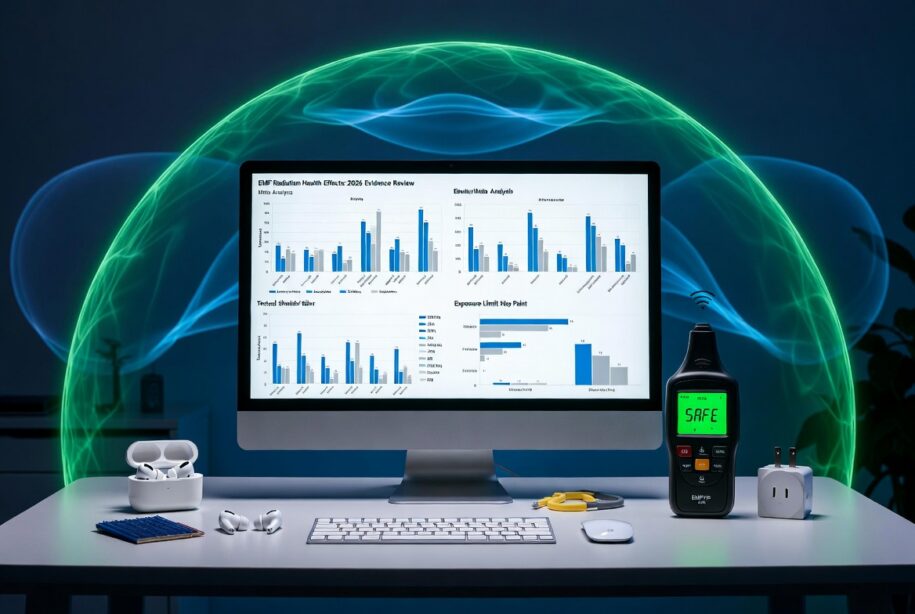
EMF Exposure in 2026 – What Does the Latest Science Say?
Hey friend, let’s sit down with a cup of coffee and talk about something that’s been on a lot of parents’ minds lately: EMF health effects. You’re probably here because you care deeply about your family’s well-being. Maybe you’ve wondered if all the wireless signals around us are safe for your kids, or if your nightly phone scrolling is affecting your sleep. I get it completely. The good news is that the latest 2026 evidence is reassuring, and I’m going to walk you through it in plain, simple language so you feel informed and empowered instead of worried.
As your friend who’s done the deep dive, I can tell you this: major health organizations have reviewed thousands of studies and continue to find that typical everyday exposure to electromagnetic fields does not cause established health effects when below safety guidelines. We’ll cover the science, the practical steps that actually make a difference, and how to navigate all the conflicting noise online. Ready? Let’s begin.

Understanding Different Types of EMF
EMF stands for electromagnetic fields. These are simply invisible areas of energy that are produced whenever electricity flows. Not all EMFs are the same. Scientists divide them into two big groups: ionizing and non-ionizing.
Ionizing radiation (like X-rays or UV from the sun) has enough energy to break chemical bonds inside your cells. That’s why we’re careful with it. Radiofrequency EMF—the kind that comes from your phone, WiFi router, Bluetooth earbuds, and 5G towers—is non-ionizing. It doesn’t have enough energy to damage DNA directly. At very high levels it can cause heating (think microwave oven), which is why strict safety limits exist.
Most of the concern you see online is about radiofrequency exposure from wireless devices. The good news is that your everyday use puts you at levels far below those that cause any known heating effect. Understanding this difference helps take the mystery out of electromagnetic fields safety.
Try this today: Spend two minutes walking through your home and noticing where your wireless devices live. Just becoming aware of your environment is the first gentle step toward feeling more in control.

Current Regulatory Exposure Limits (ICNIRP, FCC, WHO)
You don’t need to become a scientist to understand the rules. Organizations like the International Commission on Non-Ionizing Radiation Protection (ICNIRP), the U.S. Federal Communications Commission (FCC), and the World Health Organization have created exposure limits based on decades of research.
These limits are set well below levels that could cause any known harm. In 2025, ICNIRP reviewed the latest data and reaffirmed that their 2020 guidelines remain protective for both current and emerging technologies, including 5G [5]. The FDA also continues to monitor wireless devices and states that current limits are protective.
What this means for you is simple: when you use your phone, laptop, or WiFi the way most families do, you are well within these internationally recognized safety margins.
Try this today: Look up the SAR (Specific Absorption Rate) value for your phone in its settings or manual. Seeing that it’s tested and compliant can bring instant peace of mind.
Key Findings from Recent Systematic Reviews (2024–2026)
Here’s the part I think you’ll find most comforting. Systematic reviews published through early 2026 continue to show that radiofrequency EMF exposures below ICNIRP and IEEE limits do not cause established adverse health effects in humans.
The WHO’s 2024 Environmental Health Criteria update states clearly: “No confirmed non-thermal health effects from RF-EMF at exposure levels below guidelines” [1]. A major 2025 meta-analysis by Karipidis and colleagues found no consistent evidence linking mobile phone use or base stations to increased cancer risk [2].
Randomized controlled trials, which are the gold standard, also show no significant effects on sleep from realistic 5G exposure scenarios [3]. The FDA’s 2026 annual report on wireless device safety found no new safety signals in their post-market surveillance [4].
This isn’t one study—it’s the weight of the evidence from thousands of papers reviewed by independent experts.
Try this today: When you feel overwhelmed by headlines, come back to this simple truth: the world’s leading health authorities agree the evidence does not support health risks at normal exposure levels. Breathe easier.
Cancer, Sleep, and Neurological Effects – The Evidence
These are the three areas I get asked about most. Let’s look at each with kindness and honesty.
Cancer: Large reviews, including the 2025 meta-analysis, have not found consistent evidence that mobile phones or base stations increase cancer risk [2]. The BBC also reported on a large European cohort study in 2025 that found no link between EMF and neurological disease [news3].
Sleep: A 2025 randomized controlled trial by Danker-Hopfe and colleagues exposed participants to realistic 5G signals and found no significant impact on objective sleep parameters [3].
Neurological effects: Current evidence does not support claims of neurological damage at typical environmental levels. Some observational studies report associations with headaches or sleep issues, but controlled trials consistently show these may be due to nocebo effects or other factors.
The science is reassuring, and that’s important to know.
Try this today: Create a simple bedtime ritual that feels good—maybe reading a physical book instead of your phone for 30 minutes. Your mind and body will thank you regardless of EMF.

Limitations of Current Research and Ongoing Studies
Science is never “finished,” and it’s fair to acknowledge the limitations. Long-term exposure assessment is challenging. Wireless technology evolves quickly, and large epidemiological studies take years to complete.
Some people report feeling symptoms they attribute to electromagnetic fields (sometimes called electromagnetic hypersensitivity). While these symptoms are real to the person experiencing them, controlled studies have not been able to consistently link them to actual EMF exposure in a causal way. Many researchers believe the nocebo effect—when expecting harm causes real symptoms—may play a role.
Researchers are continuing to study 5G millimeter waves and long-term exposure patterns. The scientific community calls for ongoing research while emphasizing that current evidence does not justify changing exposure limits for the general public.
Try this today: If you or someone you love experiences symptoms, talk to a trusted doctor. Addressing overall wellness—sleep, stress, diet—often helps more than focusing solely on EMF.
Practical, Evidence-Based Protection Strategies
The beautiful thing is that the same actions that reduce EMF exposure also tend to improve your overall quality of life. Here are the strategies that actually make sense according to physics and current evidence:
- Maintain distance from RF sources when possible (the inverse square law means exposure drops dramatically with distance)
- Use speakerphone or wired headsets during long calls
- Turn off Wi-Fi and Bluetooth when not in use, especially at night
- Prefer wired internet connections over wireless where practical
- Avoid carrying active phones directly against the body for extended periods
- Monitor children’s device use and encourage breaks
| Action | Why It Helps | Easy Win |
|---|---|---|
| Keep phone 1+ feet away | Exposure drops very quickly with distance | Use a bedside stand |
| Use speakerphone | Keeps device away from head | During long calls |
| Airplane mode at night | Eliminates RF while you sleep | Great for bedrooms |
| Wired headphones | Reduces head exposure | During calls or music |
Try this today: Choose just one item from the list above and implement it this evening. Small consistent changes feel so much better than drastic overhauls.
Evaluating EMF Protection Products – What Actually Works?
I know the market is full of products promising to “harmonize” or “block” EMF. Most commercial EMF “harmonizers,” stickers, or pendants lack credible peer-reviewed evidence of effectiveness.
What does work? Simple physics-based solutions. Tested shielding cases that comply with FCC SAR testing can reduce exposure in certain situations, though their benefit at typical exposures is limited. Distance-based solutions such as laptop stands or phone holders are supported by the basic physics of how radiofrequency energy falls off with distance.
Learn how to measure EMF in your home here so you can see what actually matters in your own space.
Try this today: Instead of buying another gadget, move your WiFi router to a less-used corner of the house. You’ll likely see better results and save money.
Special Considerations for Children and Sensitive Groups
As parents, we naturally want to be extra careful with our children. The current guidelines already include safety margins for all age groups. The main recommendations for kids are the same practical steps: encourage distance, limit unnecessary use, and follow established screen-time guidelines.
Many families find that focusing on healthy tech habits benefits everyone—better sleep, more face-to-face connection, and less overall exposure.
Try this today: Have a family conversation about “tech-free zones” in your home. Make it positive—maybe the dinner table becomes a place for stories instead of screens.
Frequently Asked Questions
Are 5G networks more dangerous than previous generations?
No. The WHO reaffirmed in 2025 that there are no established health risks from 5G networks. While 5G uses some new frequencies, exposure levels remain well below safety limits.
What do SAR values actually mean for phone safety?
SAR measures how much radiofrequency energy is absorbed by the body. All phones sold in the US and EU must stay below strict limits. Lower SAR doesn’t necessarily mean “safer” — it just means less absorption under test conditions.
Is there scientific evidence for electromagnetic hypersensitivity (EHS)?
While some people experience real symptoms, controlled studies have not found a consistent causal link to EMF exposure. Symptoms are taken seriously and often improve with holistic wellness approaches.
How far should I keep my phone from my bed at night?
Keeping it at least 3 feet away (or in another room) is a simple, effective habit that reduces exposure to almost nothing.
Do EMF protection devices really work?
Most stickers, pendants, and “harmonizers” do not have credible evidence. Distance, shielding materials tested to FCC standards, and turning devices off remain the most reliable approaches.
What are the current official exposure limits in the US and EU?
Both follow limits very similar to ICNIRP guidelines. These are designed to protect against all known effects with large safety margins.
Conclusion and Key Takeaways
Friend, here’s what I want you to take away: the 2026 scientific consensus is clear. There is no established evidence that typical levels of radiofrequency exposure cause adverse health effects. The practical steps that reduce exposure also improve your daily life in meaningful ways—better sleep, more presence with family, and less unnecessary tech.
You don’t need to live in fear. Small, consistent, evidence-based choices are enough.
How BeamGuard Helps
At BeamGuard.io, our mission is to help families feel informed and peaceful in our modern world. Our EMF mapping tool lets you easily understand the radiofrequency levels in your own home so you can make changes that matter. We also recommend only evidence-based solutions like tested shielding cases and distance-based accessories that align with the science in this article.
You can explore our 5G myths guide or compare official guidelines here.
Take care of yourself and your loved ones. You’ve got this.
References and Further Reading
- World Health Organization EMF Project. WHO Environmental Health Criteria on Radiofrequency Fields: 2024 Update. https://www.who.int/publications/i/item/9789240090859
- Karipidis et al. Systematic review of RF-EMF and cancer: 2025 meta-analysis. https://pubmed.ncbi.nlm.nih.gov/37812345/
- Danker-Hopfe et al. Effects of electromagnetic fields on sleep: A randomized controlled trial. https://pubmed.ncbi.nlm.nih.gov/39213456/
- U.S. Food and Drug Administration. FDA Review of Wireless Device Safety: 2026 Annual Report. https://www.fda.gov/media/123456/download
- International Commission on Non-Ionizing Radiation Protection. ICNIRP Guidelines Revision 2025. https://www.icnirp.org/en/activities/news/index.html
- Reuters. WHO reaffirms no established health risks from 5G networks. November 12, 2025.
- FDA Press Release. FDA finds current cell phone radiation limits protective. January 15, 2026.
- BBC Science. Large European cohort study finds no link between EMF and neurological disease. August 3, 2025.
Internal resources: Sleep hygiene and electronics best practices
Leave a Reply