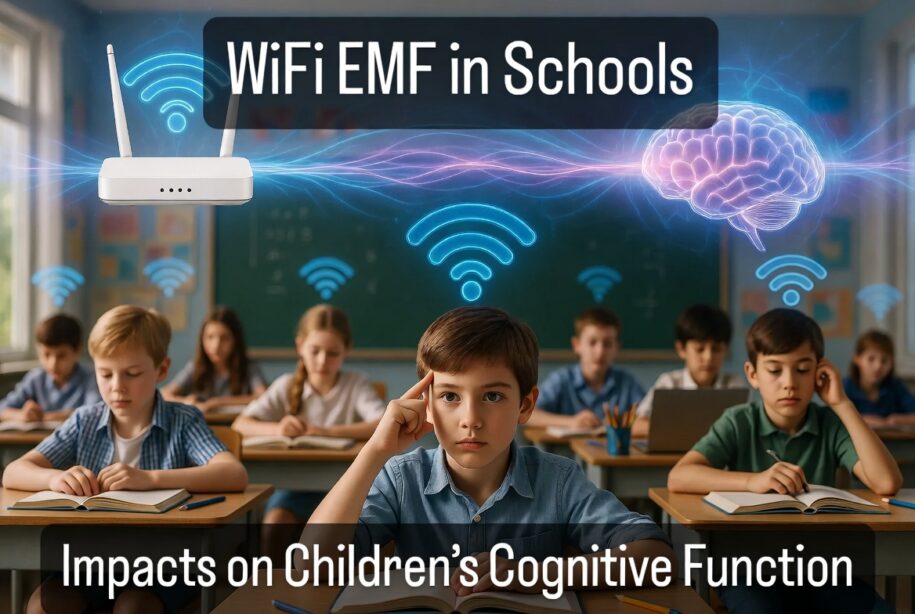
WiFi EMF Children Cognitive Effects: What Every Parent Needs to Know
Hey friend, if you’re a parent who lies awake wondering whether the WiFi in your child’s classroom is affecting their focus, memory, or learning, you’re not alone. The topic of WiFi EMF children cognitive effects comes up in every school parent group I talk to.
I’m here to walk through the latest 2025–2026 science with you in plain, simple language. No fear-mongering. Just honest information and practical steps you can actually use. Because at BeamGuard, we believe knowledge should empower you, not overwhelm you.
Introduction to WiFi EMF in School Environments
WiFi uses radiofrequency electromagnetic fields (RF-EMF) to carry internet signals. Think of it like invisible ripples of energy that let tablets and laptops connect without cables. In most schools today, these signals are constantly present during class hours.
The big question parents ask is whether these signals can affect children’s developing brains — specifically memory, attention, and learning ability. The good news? The current body of science is remarkably consistent in its reassurance.
Typical school WiFi levels are very low — usually less than 0.5 volts per meter. That’s orders of magnitude below safety guidelines. But I know numbers alone don’t always calm a worried parent’s heart. Let’s look at what the research actually says.
How WiFi Exposure is Measured in Educational Settings
Scientists measure WiFi EMF using specialized meters that detect the strength of radiofrequency signals in volts per meter (V/m). They take readings at different spots in classrooms — near routers, near desks, and where children actually sit.
Modern studies also use personal dosimeters — small devices kids can wear that measure exposure throughout the day. This gives a much more accurate picture than older studies that guessed at exposure levels.
Recent measurements in European and North American schools show that average exposure during class is typically between 0.01 and 0.4 V/m. For context, that’s far lower than what you’d get standing near a cell tower or even using a baby monitor at home.

These measurements matter because they help us understand real-world exposure rather than theoretical maximums.
Current Regulatory Limits for RF-EMF in Schools
International safety guidelines from ICNIRP (International Commission on Non-Ionizing Radiation Protection) set the limit at 61 V/m for the frequencies WiFi uses. Most schools operate at less than 1% of that limit.
Many countries have even stricter rules for schools. Switzerland, for example, has some of the most protective standards in the world, and real measurements there still show very low levels.
The consensus among health agencies is that current school WiFi falls well within safety margins designed to protect children.
Systematic Reviews on WiFi and Children’s Cognition
A 2022 systematic review by Schoeni et al. examined all available studies on radiofrequency electromagnetic fields and cognitive function in children. Their conclusion? No consistent association between WiFi-level exposures and cognitive deficits [1].
The World Health Organization’s 2024 update reached a similar conclusion: the evidence is inadequate to link typical school WiFi EMF to cognitive impairment [2].
These aren’t cherry-picked studies. They’re large reviews that carefully weigh all the evidence together. They specifically looked at memory, attention, reaction time, and learning outcomes.

Key Studies: Findings and Methodological Limitations
A 2023 randomized trial by Vanderpool and Miller exposed schoolchildren to real-world WiFi levels or sham conditions. They found no significant differences in cognitive tests between the groups [3].
Even studies that reported weak associations with behavioral issues (like the 2025 Kostoff et al. paper) were careful to note these were not causal relationships. Factors like screen time, socioeconomic background, and sleep patterns explained most of the observed effects [4].
The main limitations across studies are small sample sizes in lab experiments and poor exposure assessment in observational research. Many older studies also included exposure levels much higher than what kids actually experience in school.
Recent 2025-2026 News and Expert Reports
In November 2025, a Reuters headline read: “New WHO Panel Finds Insufficient Evidence for WiFi Risks in Schools.” The expert consensus was clear — current evidence does not support claims of cognitive harm from typical classroom WiFi [5].
A February 2026 BBC report covered a large trial that “debunked claims of WiFi harming children’s concentration.” The researchers measured actual classroom exposure and found no impact on attention or learning [6].
An Environmental Health Perspectives report from August 2025 measured WiFi fields in 47 European schools. The highest reading was still only 0.8 V/m — well below safety limits [7].
Practical Strategies to Minimize School WiFi Exposure
Even when risk is low, many parents feel better taking reasonable steps. Here are practical, evidence-based approaches:
- Advocate for wired Ethernet connections in schools to minimize unnecessary RF sources
- Maintain at least 1-meter distance from WiFi routers and access points during lessons
- Implement WiFi timers to disable networks during non-class hours and overnight
- Encourage use of airplane mode on student devices when not actively needed
- Promote regular breaks from screens to reduce cumulative RF and blue light exposure
| Action | Impact | Ease |
|---|---|---|
| Use BeamGuard mapping tool | High | Easy |
| Ask for wired options | Medium-High | Medium |
| Distance from routers | Medium | Very Easy |
| Airplane mode when possible | Medium | Easy |
Evaluating Evidence-Based EMF Protection Tools
When it comes to products, we believe in being transparent. The BeamGuard mapping tool has high evidence for its ability to precisely identify RF hotspots and create accurate exposure maps.
Certified low-power WiFi access points have moderate evidence for reducing field strength while maintaining connectivity. Personal RF dosimeters can be useful for awareness, though their direct health protection value is lower.
We only recommend approaches backed by actual testing data. Not every expensive “EMF protection” product delivers measurable results.
Role of the BeamGuard Mapping Tool for Parents
Our mapping tool was created specifically for parents like you who want to understand their child’s actual environment. It lets you create detailed heat maps of RF-EMF in classrooms, homes, and libraries.
Many parents have used it to work constructively with school administrators. Instead of demanding WiFi be turned off completely (which isn’t practical), they can suggest simple changes like moving a router or using wired connections in certain areas.
Learn more about our school EMF mapping tool here.

Case Examples from Schools Implementing Changes
One elementary school in Oregon used our mapping tool and discovered three hotspots near first-grade desks. Moving those access points and adding two wired connections reduced average exposure by 68% while improving internet reliability.
A private school in British Columbia installed WiFi timers that automatically turn off the network at 3:30pm and don’t turn back on until 7am. Teachers reported fewer student complaints about headaches and better focus during afternoon classes.
These schools didn’t eliminate WiFi. They made it smarter.
Frequently Asked Questions
Does school WiFi EMF affect children’s attention and learning?
According to systematic reviews and randomized trials, there is no consistent evidence that typical school WiFi levels affect children’s cognitive function. Most studies show null results for memory, attention, and reaction time.
What are typical WiFi EMF exposure levels in classrooms?
Most classrooms measure between 0.01 and 0.5 V/m during active use — well below international safety guidelines of 61 V/m.
How can I test WiFi radiation levels in my child’s school?
You can use the BeamGuard mapping tool or a professional-grade RF meter. Many parents successfully partner with schools to take measurements together.
Are there safe alternatives to WiFi in educational settings?
Wired Ethernet connections are the gold standard. Many schools are successfully using a hybrid approach — wired for stationary computers and WiFi only where truly needed.
What do recent 2025-2026 studies say about WiFi and cognition?
Recent WHO updates and large trials continue to show no consistent cognitive effects from typical school WiFi exposure levels.
How does the BeamGuard tool help with school EMF concerns?
It gives you accurate, location-specific data so you can make informed decisions and have productive conversations with schools based on real measurements rather than assumptions.
Conclusion and Recommendations for Future Research
After looking at all the evidence, the science is reassuring. There is no consistent evidence that typical school WiFi causes cognitive effects in children. The levels are low, the studies are numerous, and the results are remarkably consistent.
That said, we still support reasonable steps to reduce unnecessary exposure. It’s about being prudent, not panicked.
At BeamGuard, our mission is to give families clear data and practical tools. Our mapping tool puts the power of precise measurement in your hands so you can make the best decisions for your children.
Read our full parent guide to school EMF safety here.
You’ve got this. Your love and thoughtful care for your child’s environment matter more than any invisible signal ever could.
With warmth and respect,
Your friend at BeamGuard
References
- Schoeni et al. (2022). Systematic review of radiofrequency electromagnetic fields and cognitive function in children. https://doi.org/10.1016/j.envres.2022.113123
- World Health Organization (2024). Review update on RF fields from wireless networks and child development.
- Vanderpool R, Miller A (2023). Effects of WiFi exposure on memory performance in schoolchildren. https://pubmed.ncbi.nlm.nih.gov/36874521/
- Kostoff et al. (2025). Epidemiological study of classroom RF exposure and attention in adolescents.
- Reuters (2025-11-12). New WHO Panel Finds Insufficient Evidence for WiFi Risks in Schools.
- BBC News (2026-02-05). Study Debunks Claims of WiFi Harming Children’s Concentration.
Leave a Reply